NZ-NI-0358 · source record 6 October 2026
Cursed Crypt — the Curse climbs to the top of its reel
A Curse symbol does not transform the full grid. It creates Cursed Positions from its landing cell upward, then replaces only those positions with a random symbol.
Supplier sources below. Operator eligibility needs a separate check.
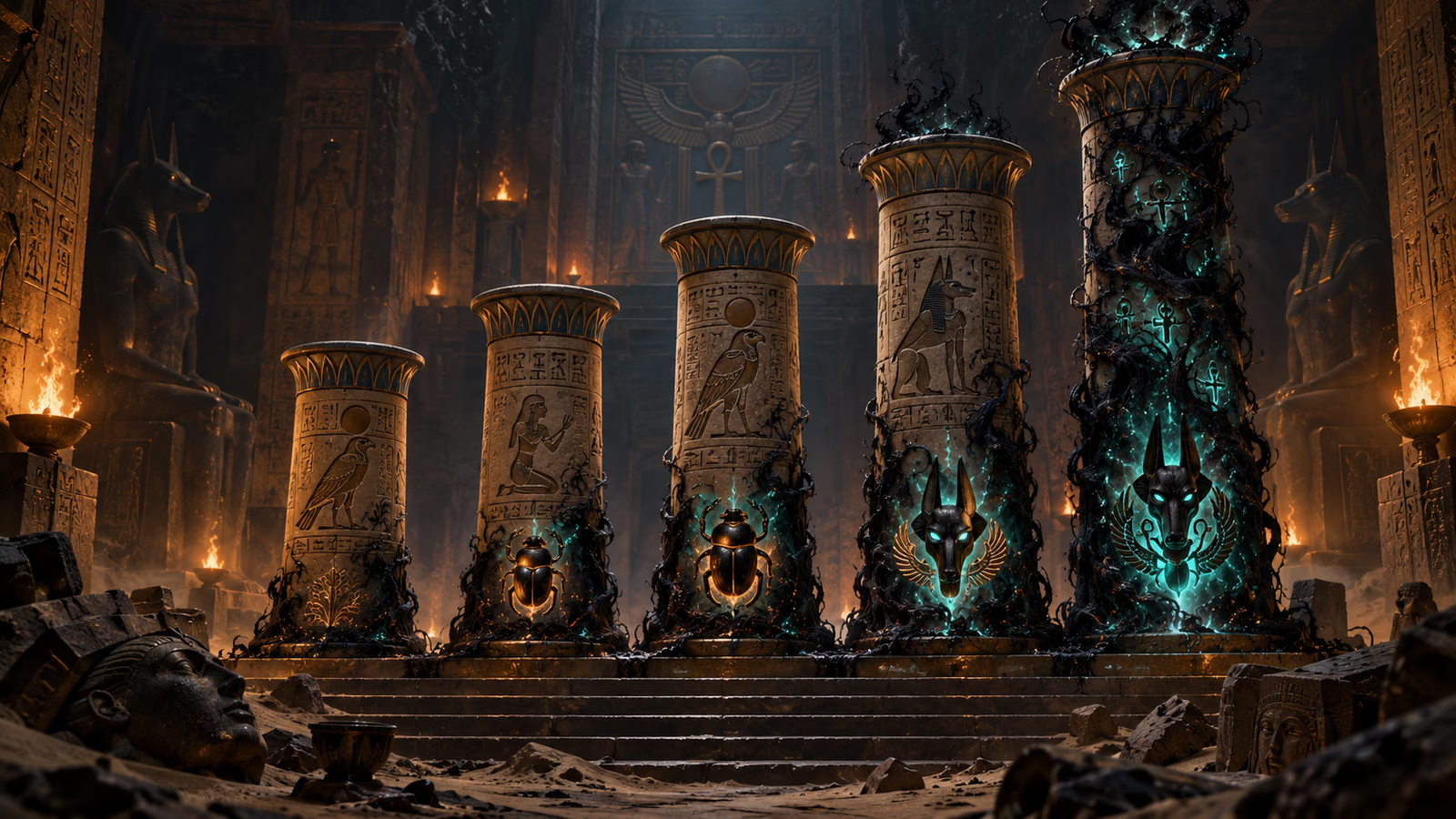
Cursed Crypt by Hacksaw Gaming is a five-reel, four-row ways game. Its official page describes one core Cursed Reels transformation and two 10-spin bonus levels. The page also states a 10,000× maximum-win claim across all game modes, while leaving RTP, stakes and the full paytable unpublished in readable form.
Cursed Reels work vertically
When a Curse symbol lands, the effect spreads upward to the top of that reel. Every covered cell becomes a Cursed Position and is replaced by one random symbol. The source does not say that positions below the Curse or cells on other reels transform, so the landing height is essential when reconstructing the result.
Wrath of Sobek increases Curse frequency
Three FS scatters in the base game award 10 free spins. The feature raises the chance of Curse symbols appearing. Two additional FS symbols in the feature award two extra spins; three award four.
Tomb of Tutankhamun narrows the replacement pool
Four FS scatters award 10 free spins in the higher feature. Here, Curse symbols can fill Cursed Positions only with high-paying symbols or Wilds. The retrigger schedule remains two extra spins for two FS symbols and four extra spins for three. Wild substitutes for paytable symbols, but the public page does not display the complete paytable.
Evidence limits
The public page confirms the layout, ways-win model, Curse direction, two bonuses and maximum-win claim. It does not provide readable RTP, stake limits, symbol payments, release version or evidence that a New Zealand casino offers the game.
Landing height defines the mask
Number rows from top to bottom before recording a Curse. The landing cell and every cell above it on the same reel form the Cursed Position mask. Cells below the landing point remain outside the effect.
A Curse on the bottom row covers four positions in the published four-row layout; a Curse on the top row covers only its own cell. Save the actual grid rather than assuming maximum coverage.
No other reel belongs to the mask unless another Curse lands there.
Building a vertical coordinate record
Assign each Curse a stable ID, reel, row and generation. List the covered coordinates in ascending vertical order. This record survives animation and makes the final replacement count auditable.
If multiple Curses appear, create a mask per reel and merge overlapping cells only once. Preserve both source IDs in the event history.
The final stopped result and server history are stronger evidence than a mid-animation image.
One random replacement symbol
Every Cursed Position created by one activation is replaced by one random symbol identity under the provider wording. Record the revealed identity and confirm that every cell in the mask uses it.
Do not select different symbols for different cells or replace existing copies elsewhere on the grid. The mask is positional and bounded vertically.
The random selection is not controlled by spin timing, stake or screen interaction.
Several Curse symbols
When Curses land on different reels, record each vertical mask and revealed symbol in the order shown by the game. The accessible page does not prove that separate Curses must choose the same replacement.
If two Curses share one reel at different heights, the lower source produces the larger mask. Use live event history to determine whether the game resolves one, both or a combined activation.
Do not double-count overlapping transformed cells in settlement.
Ways evaluation after transformation
The game uses a five-reel, four-row ways model. Obtain direction, minimum symbol count, Wild substitution and symbol values from the deployed paytable.
After the Cursed replacement completes, count eligible symbol instances across consecutive reels under the live ways rule. A transformed cell has value only through those combinations.
Keep the original grid, replacement mask and final ways settlement in one round record.
Worked bottom-row example
Suppose a Curse lands on the fourth row of reel three. The mask contains all four cells of reel three from the landing cell to the top. The game reveals one symbol and places that identity in all four cells.
The reviewer evaluates the final ways and reconciles the credited amount. Cells on reels two and four remain unchanged unless another documented feature acts.
The example explains geometry without assigning an invented payout or probability.
Worked upper-row example
A Curse on row two of reel five covers rows two and one only. It does not transform rows three and four below it. Record the two-cell mask and revealed identity.
This smaller mask is still a complete activation. The feature description does not guarantee full-reel coverage.
Comparing the two examples shows why landing height must precede any claim about transformed positions.
Wrath of Sobek entry
Three FS scatters in the base game award ten Free Spins. Save the trigger grid, three scatter coordinates, initial counter and feature label.
The mode increases the chance of Curse symbols, but the public source does not quantify that increase. Do not invent a frequency or compare it numerically with base play.
Use one Curse-mask ledger per primary Free Spin and clear it after settlement unless the live help shows persistence.
Wrath replacement pool
The standard random-symbol rule continues in Wrath of Sobek according to the accessible description. Record the actual replacement and its paytable class.
Do not restrict every result to high-paying symbols or Wilds; that narrower pool belongs to Tomb of Tutankhamun.
The mode’s enhanced frequency does not guarantee a Curse on every spin.
Wrath retriggers
Two additional FS symbols add two spins and three add four. Record scatter coordinates and counter before and after settlement.
Keep retrigger additions separate from Curse transformations. One changes duration; the other changes the current grid.
The source does not publish an award for one or more than three extra FS symbols. Do not extrapolate.
Tomb of Tutankhamun entry
Four base-game FS scatters award ten spins in the higher feature. Save all four trigger positions, initial counter and mode label.
The same vertical-mask geometry applies, but the replacement pool is limited to high-paying symbols or Wilds. Verify the revealed identity against the deployed paytable.
The stronger pool is not a guarantee of a win because ways still depend on the complete final grid.
Wild replacement
When the random replacement is Wild, every Cursed Position in the mask becomes Wild under the event. Record all coordinates and the paytable’s substitution exclusions.
Do not treat Wild as a multiplier unless the live help explicitly assigns one. Its role is substitution in the published overview.
A full or partial Wild reel can support several ways but has no standalone fixed award.
High-paying replacement
For a high symbol, confirm its classification and value in the exact paytable. A symbol described as premium by artwork alone is insufficient.
Replace every mask cell with that one identity, then count final ways. The number of repeated symbols does not guarantee consecutive-reel matches.
Record configuration and date because symbol tables can differ across versions.
Tomb retriggers
The same schedule applies: two FS symbols add two spins and three add four. Preserve the counter transition and feature-spin number.
Do not add a stronger retrigger merely because Tomb is the higher tier. Its verified improvement is the narrowed replacement pool.
At feature end, reconcile all primary spin credits and extensions with account history.
Comparing the bonus levels
Both begin with ten spins and share +2/+4 retriggers. Wrath raises Curse frequency; Tomb changes the replacement pool to high symbols or Wilds.
A comparison table should contain trigger scatters, starting spins, Curse frequency description, replacement pool and retrigger schedule. It should not add unsupported RTP or hit rates.
Label the active mode on every screenshot so a Tomb result is not used to describe Wrath.
Bonus ledger
Use one row per Free Spin with counter, Curse IDs, masks, replacement symbols, final ways, retrigger event and credit. Nested animations remain within the primary spin.
If no Curse appears, save the ordinary settled grid and counter. Absence is a valid result despite the enhanced chance.
At bonus end, sum all credits and clear mode state.
Maximum-win cap
The provider publishes 10,000× bet across all modes. Record the complete bet definition before comparing any credited result with the cap.
The cap is a ceiling, not a likely outcome or RTP. A large Wild mask cannot be converted into the cap without the full paytable and final ways.
If a calculated result exceeds the cap, preserve uncapped arithmetic and the applied limit separately.
RTP, stakes and version
Readable RTP, minimum and maximum stake, default denomination, volatility and release version are absent from the public page. Collect them from the exact deployed game with operator, currency and date.
If several RTP configurations exist, publish only the tested one. Do not combine numerical fields from separate builds.
Feature geometry cannot be used to infer theoretical return.
New Zealand availability
The global provider page does not prove real-money access in New Zealand. Verify country terms, registration eligibility, authenticated catalogue and successful launch.
NZD support, payments, verification and withdrawals are operator facts. Source them separately and date the check.
A demo is insufficient. Do not advise bypassing location controls.
Mobile and accessibility checks
On mobile, all five reels and four rows, Curse landing point, vertical mask, revealed symbol and counter must remain visible. Test portrait and landscape modes.
The upward direction needs arrows or text beyond animation. High/Wild classification should be accessible. Keyboard focus must reach help, paytable and history.
After interruption, compare mode, mask, counter, balance and round identifier with server history.
Support-ready evidence
For a transformation dispute, provide the original grid, Curse reel and row, expected upward mask, revealed symbol and final grid. For bonuses, add trigger and counter history.
Include operator, title, version, timestamp, stake, currency, balances and round identifier. State the exact missing or extra coordinate.
Never share passwords, one-time codes, private keys or seed phrases. Ask authenticated support to inspect server events.
Session controls
A low Curse position or higher-tier symbol pool can look promising, but neither makes a win guaranteed or another trigger due.
Set stake, spending and time limits before play. Do not increase stakes to chase a full-reel Wild or 10,000× cap.
Mechanical knowledge supports verification, not prediction. Use responsible-play controls and stop at the chosen boundary.
Publication checklist
- Record Curse reel and landing row first.
- Build the mask from the landing cell upward only.
- Keep cells below and other reels outside the mask.
- Replace the whole mask with one random symbol per activation.
- Evaluate the final five-by-four ways grid.
- Keep Wrath’s frequency change separate from Tomb’s pool restriction.
- Apply +2 spins for two FS and +4 for three.
- Verify high-paying classifications in the deployed paytable.
- Report 10,000× only as a cap.
- Verify RTP, stakes and New Zealand access from primary evidence.
Editorial assessment
Cursed Crypt is governed by vertical geometry. Landing height defines the transformed area, and bonus level controls frequency or replacement pool without changing that upward rule.
A rigorous review maps coordinates before reading outcomes and leaves RTP, stakes and local availability unclaimed until verified in the deployed game.
Overlapping masks on one reel
If two Curse sources appear on the same reel, create both upward masks before merging them. The lower landing point contains every cell covered by the higher one, but the event history should retain both sources.
Count each final coordinate once when reconstructing the transformed grid. Use the live event order to determine whether one or two random identities are selected; the public summary does not settle that edge case.
Do not assume the lower Curse always overrides the higher. Preserve the actual reveal and request primary clarification when necessary.
Mask interaction with existing Wilds
An existing Wild inside the vertical mask is replaced by the selected symbol under the general transformation wording unless the deployed help provides an exception. Record its pre-state before conversion.
If the selected identity is Wild, the final cell remains Wild but still belongs to the feature mask. This is not evidence that the original Wild persisted untouched.
Substitution and special-symbol exclusions must come from the paytable rather than visual similarity.
Several ways after a full reel
A four-cell replacement on one reel can create many eligible symbol instances, but ways require matching symbols across the required consecutive reels. Count instances reel by reel and apply the exact directional rule.
Do not multiply the number of transformed cells by a paytable value without checking connections. A full high-symbol reel can still fail to complete a valid way if adjacent reels do not match.
Show the final instance counts and combination formula beside the round credit.
Version comparison protocol
Attach each test to operator, build, currency and date. Compare layout, ways direction, upward mask, replacement identity rule, bonus triggers, Tomb pool and retriggers individually.
Archive one top-row, one bottom-row and one multi-Curse activation with the matching help screen. These reference rounds reveal a genuine geometry change and distinguish it from a cropped mobile view.
If primary sources conflict, retain both dated states. Do not merge RTP or stakes from one build with symbol pools or trigger rules from another.
Practical reader decision points
Before play, verify live RTP, complete stake, cap, country eligibility and responsible-play controls. During a spin, ask which reel and row received the Curse, what upward cells form the mask and what single symbol was selected.
During a bonus, add the tier, counter and retrigger history. Those fields reconstruct the result without suggesting a bottom-row Curse or Wild replacement is due.
After settlement, clear the mask and apply the pre-set session boundary. A large transformed reel is temporary round state, not stored value.
Round-reconstruction worksheet
Draw the five-by-four grid and label every coordinate. Circle each Curse source, shade cells from that row upward and write the revealed identity beside the mask. For several reels, use separate patterns.
Compare the expected mask with the final grid, then calculate ways from the transformed state. This exposes extra cells below the source, missed top cells and accidental cross-reel replacement before monetary reconciliation.
RTP remains outside the worksheet because it is a long-run theoretical field rather than one transformation result.
Final verification note
Before revision, reproduce the ten-spin starts, +2/+4 retriggers, Wrath frequency description, Tomb high/Wild pool and 10,000× cap in current official help.
Any field that cannot be reproduced should retain its source date and be labelled configuration-specific, not current evidence for a New Zealand casino account.
One covered reel, two different quantities
Here is a hypothetical geometry check, not a played result. Number rows 1–4 from top to bottom and reels 1–5 from left to right. Suppose two Curse sources are visible on reel 3, one at row 2 and another at row 4. Their individual upward masks contain two and four cells respectively. The raw mask memberships total six, but their union contains only four distinct positions: reel 3, rows 1–4. Rows 1–2 belong to both masks and must not become two additional board cells.
That union describes coverage, not the scheduler. The summary does not establish whether both overlapping activations choose independent identities or how one reveal supersedes another. For the following calculation, assume the completed event record actually shows all four positions as symbol A after resolution. This is an observed-state assumption for the example, not a rule invented for overlapping Curses.
Before transformation, assume the board has the following eligible A instances. The one A already on reel 3 is inside the replaced area.
| Reel | A instances before | A instances after the assumed final reveal |
|---|---|---|
| 1 | 2 | 2 |
| 2 | 3 | 3 |
| 3 | 1 | 4 |
| 4 | 1 | 1 |
| 5 | 2 | 2 |
Four covered positions therefore produce a net increase of three A instances on that reel, not four: one matching instance was already present. The two Curse source symbols, four covered cells, six mask memberships and three additional A instances are four different counts. Keeping them distinct prevents geometry from inflating a monetary claim.
For an explicit conditional ways calculation, suppose active help validates left-to-right five-symbol A combinations and each choice of one eligible instance per reel is a separate payable way. The before-state product is 2 × 3 × 1 × 1 × 2 = 12. The assumed final-state product is 2 × 3 × 4 × 1 × 2 = 48. Neither product is the game’s published total number of possible ways; both concern only this one symbol and this particular hypothetical board.
If the accepted paytable basis were 0.2 base bets per five-A way, the final subtotal would be 48 × 0.2 = 9.6 base bets. At an illustrative base bet of 0.50 account-currency units, that is 4.80 units before any applicable settlement limit. Those paytable and stake values are assumptions, not figures supplied by the provider. Do not add the before-state 12 ways as another paid result: a comparison snapshot is not an independently credited evaluation.
If that hypothetical ordinary round actually debited 0.50 and credited 4.80, its net change would be +4.30, not +4.80 profit. For a Free Spin result, reconcile against the feature’s documented entry cost instead of inventing another 0.50 debit for every Curse transformation or extension.
Changing reel 1’s final A count to zero makes this five-reel A product zero despite the fully transformed third reel. That says nothing about shorter combinations or other symbols, which require their own rules. Tomb’s high-symbol/Wild restriction changes what may be revealed, not whether every final board necessarily supplies adjacent-reel matches.
Extensions do not measure coverage
Suppose Wrath or Tomb has one scheduled spin remaining before it is consumed, and that spin then lands three additional FS symbols. The published four-spin extension gives the illustrative counter 1 − 1 + 4 = 4. Two extra FS symbols would instead give 1 − 1 + 2 = 2. These additions are selected by the FS count, not by the four-cell Curse mask or two overlapping Curse sources. A larger transformed area must not be converted into extra scheduled spins.
Frequently asked questions
Which way does the Curse spread? Upward to the top of its reel.
What replaces Cursed Positions? One random symbol.
How many spins does each bonus start with? Ten.
What changes in Tomb of Tutankhamun? Replacements are limited to high-paying symbols or Wilds.
Is RTP published on the page? No readable RTP is shown.
Is New Zealand availability confirmed? No.
Official source
Bottom line: record the Curse height first; it defines the exact transformed area.
How to verify the version you can actually open
A provider page proves that a title exists and describes the supplier's intended rules. It does not prove that a casino accepts players in New Zealand, that the title is enabled for a particular account, or that the highest published RTP is the version in the lobby. Treat availability, operator eligibility and product configuration as three separate checks.
Start with identity, then configuration
Open the game only through the authenticated casino lobby. The information or help panel should identify Hacksaw Gaming, the exact title and the active mathematical return. Compare the reel or grid layout, paylines or cluster rules, named features and symbol behaviour with the official product material. Similar artwork or a matching title is not enough when the help file is missing or inconsistent.
When the supplier publishes several RTP values, report all of them as configurations. Do not assume the highest option is deployed. RTP is a theoretical long-run measure across a very large number of rounds; it is not a refund rate for one player and cannot predict the next result. Volatility is different: it describes how unevenly results are distributed on the provider's scale.
Read stake controls as money, not interface decoration
Provider sheets often quote a reference range in euros. That range does not establish New Zealand-dollar support or the limits in a specific account. Before a paid round, identify the total amount that will leave the balance. If the interface separates denomination, coins and lines, verify the combined total. If Extra Bet is active, calculate its full cost before pressing spin.
Feature-buy prices are multiples of the current bet, not promised returns. A 100x purchase at a $1 stake costs $100; at a $2 stake it costs $200. Availability can vary by market and some mathematical configurations may not support the control. If the live help does not explain the price, delivered feature and active RTP, leave the option unused.
Keep simulation figures in their proper scope
A game sheet may publish a maximum result observed in a large simulation. That is not automatically the contractual maximum payout and never describes a likely session. Preserve the provider's wording, sample size and configuration. Check the live rules for a binding cap and the operator terms for any separate payout limit. Do not turn an extreme result into a promotional headline.
Audit a disputed round
If an animation freezes or a connection drops, do not repeat the wager immediately. Reopen the game through the authenticated lobby and inspect round history. Record the time, total stake, balance movement and round identifier. The result can be settled by the gaming system even when the device never displays the final animation. Send evidence through verified operator support; never disclose a password, recovery phrase or one-time code.
Read the paytable as a calculation document
The paytable should explain what creates a win, which symbols substitute, where special symbols can land and how multiple awards combine. For line games, confirm direction and active paylines. For cluster games, confirm adjacency, minimum group size and the order of collection. For respins, identify what remains locked, what resets the counter and what ends the feature. A graphic effect can illustrate those rules but cannot replace them.
Separate addition from multiplication. Several prize values may be added before a multiplier applies, while reel-specific multipliers can sometimes multiply together only when each reel participates in the same win. Reconstruct one low-stake result from game history. If the arithmetic cannot be matched to the help file, stop and ask the operator rather than guessing.
Do not confuse hit frequency with a profitable round
Provider sheets can publish hit frequency or category probabilities. A hit simply means a round returned a qualifying amount; it can be smaller than the stake. “Big”, “Mega” or “Epic” thresholds are provider reporting categories, not promises. They are useful for comparing mathematical versions only when definitions and samples are the same.
Random outcomes do not become due after a long gap. A feature that appeared repeatedly in a demo or marketing clip has no obligation to repeat in a funded session. Previous rounds do not create a debt from the next random result.
Confirm market and device behaviour independently
A title can exist in the supplier catalogue while an operator disables it for a territory, currency, device or bonus. Language localisation is not evidence of legal availability. Confirm the operator's identity, accepted countries and current lobby separately from the provider review.
On mobile, verify that balance, total bet, feature state and help remain visible without overlap. On desktop, check that browser zoom does not hide a purchase control or change the apparent denomination. Mathematical configuration should not change merely because the screen changes; if the help shows another RTP, treat it as a different deployment and record it.
Keep a compact evidence record
For any fact used in a review, save the title, provider, official URL, document date when available, access date and exact territorial scope. For a live session, add the operator domain, Game ID, RTP, currency and a non-sensitive screenshot of the help panel. This makes later corrections possible when a supplier updates a sheet or an operator changes configuration.
Missing information should remain missing. Do not estimate an RTP from results, convert a euro reference range into an operator's NZD limit, or treat another casino's configuration as evidence. A transparent “not confirmed” is more useful than a precise-looking number without the correct source.
Use limits that survive the feature design
Collection meters, expanding grids, sticky symbols and near misses can make a session feel unfinished. Unless the rules explicitly preserve progress, the visible state has no value after the round or feature ends. Set a money limit and time limit before launch, count feature buys immediately, and stop at the limit even when a meter appears close to an upgrade.
No random game is an income plan. Do not borrow, use essential funds or raise the stake to recover a loss. If play stops feeling recreational, use timeout, deposit-limit or self-exclusion tools and consult the site's responsible gambling guide.
Primary source and correction path
This guide separates documented product information from market availability. Check the official source and the game help inside the exact version offered before making a decision.
