NZ-NI-0322 · source record 6 October 2026
Mayana — lock the connection, then expand the grid
Three connecting symbols start the respin sequence; matching additions can widen the board and increase winning ways before the final multiplier check.
Supplier sources below. Operator eligibility needs a separate check.
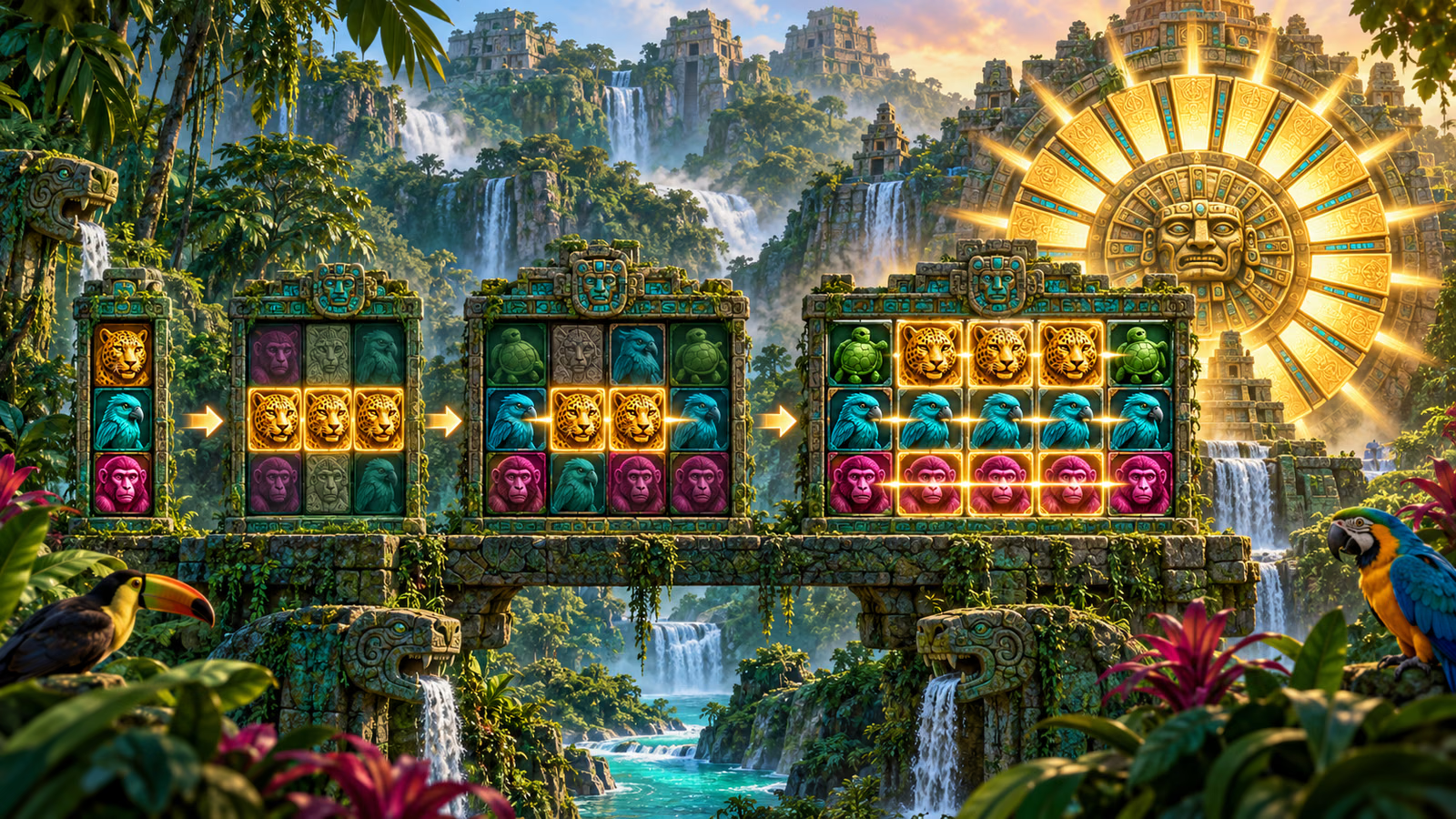
Mayana by Quickspin begins from a smaller reel state and can expand into a 3×5 board. The published respin trigger is three connecting matching symbols in a row.
Lock and expand
Triggering winning symbols lock before the next respin. Additional matching symbols can extend the connection through the middle, left or right side and increase the winning ways by ×1, ×2 or ×3, depending on the combination and the grid expansion.
The multiplier attached to winning ways is part of the expansion rule. It should not be reported as a standalone multiplier applied to every outcome.
Mucha Mayana final spin
On the final spin, the Mucha Mayana feature may activate only if the reel grid has fully expanded. The official page states that the spin multiplier can reach ×20.
Evidence limits
The short HTML overview omits numerical RTP and stakes, while its linked sheet supplies reference values and a 3×3 starting grid. The complete active respin limit and New Zealand availability still require deployment evidence.
Frequently asked questions
Verified rule set
Quickspin describes Mayana as a game that starts with a smaller reel state and can expand to a board three rows high and five reels wide. The published respin trigger is a row of three connected matching symbols. Those winning symbols lock before the next respin.
Additional matching symbols can extend the connection through the middle, left or right side. As the board expands, winning ways can be multiplied by ×1, ×2 or ×3 depending on the combination and expansion state. On the final spin, Mucha Mayana may activate only when the grid has fully expanded, with a spin multiplier reaching up to ×20.
The linked supplier sheet identifies a 3×3 start and reference numerical model. It does not establish the complete active expansion table, respin limit, contractual maximum or New Zealand availability. Those fields still require deployed help and operator evidence.
The original supplier reference
The official Mayana sheet identifies mayana, a 96.63% total, volatility 4.85 on a five-point scale, euro stakes of €0.25–€100 and a €1 default. These are reference fields for that identifier, not confirmation of an operator’s currency or configured help. The sheet also specifies the nine-position 3×3 start; its 16:9 field describes presentation, not reel geometry.
Its return panel assigns 96.63% to Base Game and repeats that total. Do not add the repeated total to create 193.26%, or infer that respins contribute nothing because there is no separately labelled Free Game component. The panel does not isolate the return associated with expansion stages or Mucha Mayana.
The maximum-payout row records 13,254× in one billion simulated spins. That is an observed simulation maximum, not an explicit contractual cap or a promise that one billion plays produce that result. It is also not a value obtained by multiplying the visible ×3 and ×20 labels together. A binding maximum needs the active rules’ separate limit wording.
One locked coordinate can belong to two connections
Consider an illustrative history in which the live evaluator has accepted two same-symbol connections. Label the first connection C1, C2 and C3, and the second C2, C3 and C4. These identifiers name distinct board positions, not an assertion about Mayana’s permitted line geometry. The example assumes the history has already verified both connections under the active rules.
The two connections contain six coordinate memberships but only four unique symbols. C2 and C3 appear in both. The locked-set register therefore contains {C1, C2, C3, C4}, not six symbols. This does not decide whether both connections receive separate pay evaluations: valid winning ways and the number of unique locked cells are different measurements.
| Accepted event | Coordinates in that connection | New positions added to the locked set | Unique positions now stored |
|---|---|---|---|
| First qualifying connection | C1, C2, C3 | Three | Three |
| Second qualifying connection | C2, C3, C4 | C4 only | Four |
| Later accepted extension | C3, C4, C5 | C5 only | Five |
The last row adds one previously absent position, even though its accepted connection has three members. If the client reports two distinct ways for the second event, retain both way records, but keep the four-cell union in the lock register. Summing connection lengths would corrupt that register and could incorrectly suggest that the board has become fuller than it is.
Grid expansion needs a separate register. Nine active starting positions and three locked symbols describe two different counts. A later fully expanded board has fifteen active positions; that does not mean all fifteen are locked winners. Conversely, five stored locks do not prove a particular intermediate width. Match each expansion to the actual active-board mask, rather than inferring it from the number of locked cells.
At the terminal check, save three independent observations: active grid dimensions, the actual final-spin state and the Mucha Mayana result. A 3×5 board without an identified final spin is not enough to assign the published last-spin feature. Nor should a ×20 label seen in the artwork replace the value reported by the completed round.
What counts as a connected trigger
Map the initial visible cells and mark the three matching symbols that touch in the published row pattern. Use coordinates rather than visual proximity alone. Decorative paths, symbols separated by a gap or three matching icons outside the permitted connection should not be called a trigger without game-history confirmation.
The accessible description establishes three connected matching symbols in a row but does not provide every eligible orientation or edge case. The deployed paytable must show whether connection is horizontal, vertical, diagonal or governed by a dedicated route. Do not infer the geometry from one animation.
Once the trigger message appears, assign stable IDs C1, C2 and C3 to the original winning symbols. These form the first locked set and the reference for every later extension.
Locked-symbol ledger
Before each respin, save the current grid dimensions and all locked coordinates. After the respin, identify only newly matching symbols that connect to the existing set. Add those cells to the ledger and preserve prior locks.
A matching symbol elsewhere on the board should not be added automatically if it does not extend the connection under the rules. Conversely, a new connector may create access to another part of the grid; record the server sequence rather than guessing from the final board.
Locked symbols belong to one feature round. A respin should not create a second paid wager. Compare the balance and round ID through the full sequence, and stop if the client appears to charge unexpectedly.
Expansion-state table
Create a row for every grid state. Include respin number, active rows, active reels, newly opened cells, connection coordinates and winning-ways multiplier. The linked sheet specifies a 3×3 start and 3×5 expansion, but not the complete intermediate transition table; capture that from the live version.
Do not describe an opening animation as expansion unless playable positions actually become active. Confirm new cells through symbols, pay evaluation or the official state indicator. A wider decorative frame does not establish additional ways.
When both left and right sides open, preserve the order supplied by the event history. This can matter when determining which new matching symbol completed the next connection and which multiplier applied.
Winning-ways multipliers
Quickspin names ×1, ×2 and ×3 in connection with matching expansion and winning ways. Record the exact combination, grid state and multiplier displayed for each settled win. The multiplier is not a permanent account value and should not be applied to every symbol on the board without the live calculation rule.
Keep three fields separate: number of winning ways, ways multiplier and credited win. A ×3 ways state does not mean that the stake, RTP or every later award is tripled. The feature help must explain duration and settlement.
If more than one connection pays in a state, list each valid set and use the server history to determine whether multipliers apply individually or to a combined total. Never select the highest published multiplier simply because the board has expanded.
Middle, left and right extension
The provider description allows matching additions through the middle, left or right. Mark the side or region for every newly connected symbol. This reveals whether the chain widens, fills an internal gap or extends toward an unopened board edge.
Do not assume symmetrical behaviour. A left extension observed in one round does not prove that the right side uses identical thresholds. The live help should define how a new symbol must touch the existing group and which expansion it unlocks.
A compact visual can show the locked core in one pattern and each generation of additions in another. Use labels as well as colour so readers can follow the sequence on mobile or with colour-vision differences.
Final-spin identification
The Mucha Mayana check belongs to the final spin. Record how the game identifies that spin: remaining counter, terminal respin condition or final-state message. Do not label an earlier expansion step “final” simply because the grid looks nearly complete.
The grid must be fully expanded before the published final-spin feature can activate. Capture all three rows and five reels as active, then save the Mucha Mayana result. If the board is not 3×5, do not apply the up-to-×20 statement.
“May activate” and “up to ×20” are both qualified. Full expansion does not promise activation, and activation does not promise the maximum multiplier. Record the value actually displayed.
Mucha Mayana settlement
For a qualifying final full-grid spin, preserve the base win, displayed feature multiplier and settled total. The live game sheet must explain whether the multiplier applies to the entire spin, specific ways or another subtotal. Avoid multiplying figures manually without that rule.
If the displayed value is below ×20, report the actual value. The ×20 figure is a published ceiling, not an expected outcome. A non-activating final spin remains a valid feature result and should not be described as missing an award.
Where another ways multiplier is also visible, the order of operations must come from the paytable or server calculation. Do not automatically multiply ×3 by ×20 to publish an unsupported ×60 claim.
Worked connection example
Imagine an initial state where three matching symbols connect and lock. The first respin adds one matching symbol on the right, opening new playable positions and changing the displayed winning-ways state. The next respin fills a middle connection and expands another part of the board.
If the sequence reaches a complete 3×5 grid, the final spin becomes eligible for the Mucha Mayana check. The ledger records whether the feature activates and which multiplier actually appears. If the grid stops short, no final full-grid multiplier is assigned.
This hypothetical illustrates the record structure. It does not claim a starting layout, transition probability, multiplier frequency or likely payout.
Ending the respin sequence
The public overview does not provide a readable complete respin limit or every termination condition. Record the remaining counter or state message from the live game and preserve the terminal grid. Do not invent unlimited respins because matching symbols can extend a chain.
If a replacement produces no qualifying connection, check whether the feature ends immediately or proceeds to a defined final spin. The deployed help is the authority. A visually matching but disconnected symbol should not prolong the sequence by assumption.
After settlement, compare the feature total with account history and keep the original round ID. Every respin and final event belongs to that round unless the server record says otherwise.
RTP, stakes and maximum exposure
Open the deployed help and collect initial layout, expansion states, connection geometry, pay evaluation, symbol values, ways multipliers, respin rules, final-spin definition, Mucha Mayana calculation, stake range, RTP configuration and maximum exposure. Record version and date.
RTP cannot be derived from ×1–×3 ways multipliers or the ×20 ceiling. Maximum exposure cannot be inferred by multiplying visible ceilings without the certified calculation and feature caps.
If multiple RTP variants exist, publish only the value displayed in the tested deployment. Do not combine one operator’s return with another version’s expansion table.
New Zealand availability
Quickspin’s global product page supports the mechanic summary but does not confirm real-money availability in New Zealand. Verify operator country terms, eligible account access, signed-in catalogue and matching game help. A demo or provider page is insufficient.
Currency, payment methods, verification and withdrawal conditions belong to the operator. Do not infer them from the game page or another jurisdiction.
Date the access check and never recommend bypassing location controls. If local availability remains unverified, state that clearly.
Mobile and accessibility review
At narrow width, the changing grid boundaries, locked connection and multiplier state must remain visible together. Test every expansion step in portrait and landscape. A responsive layout should not hide newly opened cells behind controls.
Use patterns or labels for original locks, later connectors and inactive positions. Reduced-motion mode must still reveal state changes and the final multiplier. Keyboard focus should reach help, paytable and history.
After interruption, compare grid dimensions, locked IDs, current multiplier, final-spin status, balance and round ID before another action. Allow server restoration to finish.
Support evidence
Save title, provider, version, operator, time, stake, currency, balances and round ID. Add the triggering connection, every locked-set update, expansion-state table, ways multiplier, terminal grid, Mucha Mayana result and settled total.
For a missing expansion, identify the new matching coordinate and how it connects. For a multiplier dispute, supply the base ways and displayed calculation. Ask authenticated support for the server event log and applicable rules.
Never share passwords, authentication codes, private keys or seed phrases. Redact unrelated personal data before editorial use.
Suitability and session control
Mayana may suit readers who enjoy visible board development and can follow a state ledger. It may be unsuitable for anyone who interprets a nearly complete grid as value owed by the next respin or who chases the ×20 ceiling.
Set stake, spend and time limits before play. The player does not control which matching symbols appear or whether Mucha Mayana activates under the published description. Previous expansion does not make a later full grid inevitable.
Treat settlement as the end of the state. Partial grid progress should not be mentally carried into another paid round.
Publication checklist
- Verify three connected matching symbols before declaring a trigger.
- Preserve the original locked set and each added connector.
- Record grid dimensions at every respin.
- Separate winning ways, ways multiplier and credited win.
- Label middle, left and right extensions accurately.
- Require a complete 3×5 grid for the final Mucha Mayana check.
- Treat ×20 as a ceiling, not a fixed award.
- Source termination, RTP, stakes and maximum from live help.
- Confirm New Zealand access only through operator evidence.
- Test expansion diagrams and tables on mobile.
Editorial conclusion
Mayana is best reviewed as a growing connection graph. The initial three-symbol match establishes the locked core; each qualifying addition changes the graph and may expand the playable grid or winning-ways state. A state table makes that process verifiable.
The final full-grid spin is a separate checkpoint. Mucha Mayana remains conditional and its multiplier remains capped at “up to ×20”. Keeping those qualifiers, along with unresolved configuration and local-access fields, prevents the expansion narrative from becoming an invented payout promise.
Connection-quality review
Before publishing a diagram, verify that every line between symbols represents an accepted game connection, not merely the shortest visual route. Number the generations: generation zero for the triggering three, generation one for the first matching additions, and so on. This preserves the order in which the playable area changed.
For each generation, state whether the expansion occurred through the middle, left or right and link it to the new grid dimensions. If two additions appear during one respin, the server history should show whether they belong to one simultaneous event or sequential updates. The article should mirror that evidence.
Do not remove a locked symbol from the illustration just because it stops contributing to the most recent highlighted way. The feature description says triggering winners lock, and the deployed rules determine persistence. A complete timeline is more reliable than a final promotional frame.
Settlement worksheet
The settlement sheet should contain base winning ways, current ways multiplier, Mucha Mayana value where eligible, any other documented adjustment and final credited amount. Leave a field blank when the game does not apply it. This prevents ×3 or ×20 from being inserted into every row.
Compare the calculated components with account history, but let the server record resolve rounding and calculation order. If the totals differ, preserve the version and ask support for the exact formula rather than changing the article to match an unsupported manual calculation.
The worksheet also needs a mode-state column: initial grid, expansion respin or final full-grid spin. A multiplier documented for one state should never leak into another.
Maintenance and direct answers
Archive the provider page, deployed help, grid screenshots and round histories under one date and version. Recheck connection geometry, starting layout, expansion route, multiplier table, RTP and maximum after an update. Run duplicate, word-count, internal-link and mobile checks before replacing the published page.
Does every group of three matching symbols trigger? Only a qualifying connected row under the game rules. Does a fully expanded grid automatically award ×20? No; the final-spin feature may activate and the multiplier can reach that ceiling. Can a partial grid use the final-state multiplier? Not under the published condition. Is New Zealand access proven by the provider page? No.
These answers make the finished review useful without pretending to know missing probabilities. A reader can reconstruct the expansion, see exactly where a multiplier entered and identify which facts still require the live configuration.
What starts a respin? Three connecting matching symbols in a row.
Which symbols lock? The winning symbols that created the connection.
How large can the board become? Three rows and five reels.
How can winning ways change? By ×1, ×2 or ×3 through matching expansion.
When can the ×20 feature appear? On the final spin after full grid expansion.
Is New Zealand availability confirmed? No.
Official source
Bottom line: preserve the connected lock, record each expansion and reserve the Mucha Mayana check for the final full-grid spin.
How to verify the version you can actually open
A provider page proves that a title exists and describes the supplier's intended rules. It does not prove that a casino accepts players in New Zealand, that the title is enabled for a particular account, or that the highest published RTP is the version in the lobby. Treat availability, operator eligibility and product configuration as three separate checks.
Start with identity, then configuration
Open the game only through the authenticated casino lobby. The information or help panel should identify Quickspin, the exact title and the active mathematical return. Compare the reel or grid layout, paylines or cluster rules, named features and symbol behaviour with the official product material. Similar artwork or a matching title is not enough when the help file is missing or inconsistent.
When the supplier publishes several RTP values, report all of them as configurations. Do not assume the highest option is deployed. RTP is a theoretical long-run measure across a very large number of rounds; it is not a refund rate for one player and cannot predict the next result. Volatility is different: it describes how unevenly results are distributed on the provider's scale.
Read stake controls as money, not interface decoration
Provider sheets often quote a reference range in euros. That range does not establish New Zealand-dollar support or the limits in a specific account. Before a paid round, identify the total amount that will leave the balance. If the interface separates denomination, coins and lines, verify the combined total. If Extra Bet is active, calculate its full cost before pressing spin.
Feature-buy prices are multiples of the current bet, not promised returns. A 100x purchase at a $1 stake costs $100; at a $2 stake it costs $200. Availability can vary by market and some mathematical configurations may not support the control. If the live help does not explain the price, delivered feature and active RTP, leave the option unused.
Keep simulation figures in their proper scope
A game sheet may publish a maximum result observed in a large simulation. That is not automatically the contractual maximum payout and never describes a likely session. Preserve the provider's wording, sample size and configuration. Check the live rules for a binding cap and the operator terms for any separate payout limit. Do not turn an extreme result into a promotional headline.
Audit a disputed round
If an animation freezes or a connection drops, do not repeat the wager immediately. Reopen the game through the authenticated lobby and inspect round history. Record the time, total stake, balance movement and round identifier. The result can be settled by the gaming system even when the device never displays the final animation. Send evidence through verified operator support; never disclose a password, recovery phrase or one-time code.
Read the paytable as a calculation document
The paytable should explain what creates a win, which symbols substitute, where special symbols can land and how multiple awards combine. For line games, confirm direction and active paylines. For cluster games, confirm adjacency, minimum group size and the order of collection. For respins, identify what remains locked, what resets the counter and what ends the feature. A graphic effect can illustrate those rules but cannot replace them.
Separate addition from multiplication. Several prize values may be added before a multiplier applies, while reel-specific multipliers can sometimes multiply together only when each reel participates in the same win. Reconstruct one low-stake result from game history. If the arithmetic cannot be matched to the help file, stop and ask the operator rather than guessing.
Do not confuse hit frequency with a profitable round
Provider sheets can publish hit frequency or category probabilities. A hit simply means a round returned a qualifying amount; it can be smaller than the stake. “Big”, “Mega” or “Epic” thresholds are provider reporting categories, not promises. They are useful for comparing mathematical versions only when definitions and samples are the same.
Random outcomes do not become due after a long gap. A feature that appeared repeatedly in a demo or marketing clip has no obligation to repeat in a funded session. Previous rounds do not create a debt from the next random result.
Confirm market and device behaviour independently
A title can exist in the supplier catalogue while an operator disables it for a territory, currency, device or bonus. Language localisation is not evidence of legal availability. Confirm the operator's identity, accepted countries and current lobby separately from the provider review.
On mobile, verify that balance, total bet, feature state and help remain visible without overlap. On desktop, check that browser zoom does not hide a purchase control or change the apparent denomination. Mathematical configuration should not change merely because the screen changes; if the help shows another RTP, treat it as a different deployment and record it.
Keep a compact evidence record
For any fact used in a review, save the title, provider, official URL, document date when available, access date and exact territorial scope. For a live session, add the operator domain, Game ID, RTP, currency and a non-sensitive screenshot of the help panel. This makes later corrections possible when a supplier updates a sheet or an operator changes configuration.
Missing information should remain missing. Do not estimate an RTP from results, convert a euro reference range into an operator's NZD limit, or treat another casino's configuration as evidence. A transparent “not confirmed” is more useful than a precise-looking number without the correct source.
Use limits that survive the feature design
Collection meters, expanding grids, sticky symbols and near misses can make a session feel unfinished. Unless the rules explicitly preserve progress, the visible state has no value after the round or feature ends. Set a money limit and time limit before launch, count feature buys immediately, and stop at the limit even when a meter appears close to an upgrade.
No random game is an income plan. Do not borrow, use essential funds or raise the stake to recover a loss. If play stops feeling recreational, use timeout, deposit-limit or self-exclusion tools and consult the site's responsible gambling guide.
Primary source and correction path
This guide separates documented product information from market availability. Check the official source and the game help inside the exact version offered before making a decision.
