NZ-NI-0336 · source record 6 October 2026
Treasure Island — two Barrel Wilds call the Pirate Attack
Three bonus systems share the same pirate setting, but each follows a different trigger and persistence rule.
Supplier sources below. Operator eligibility needs a separate check.
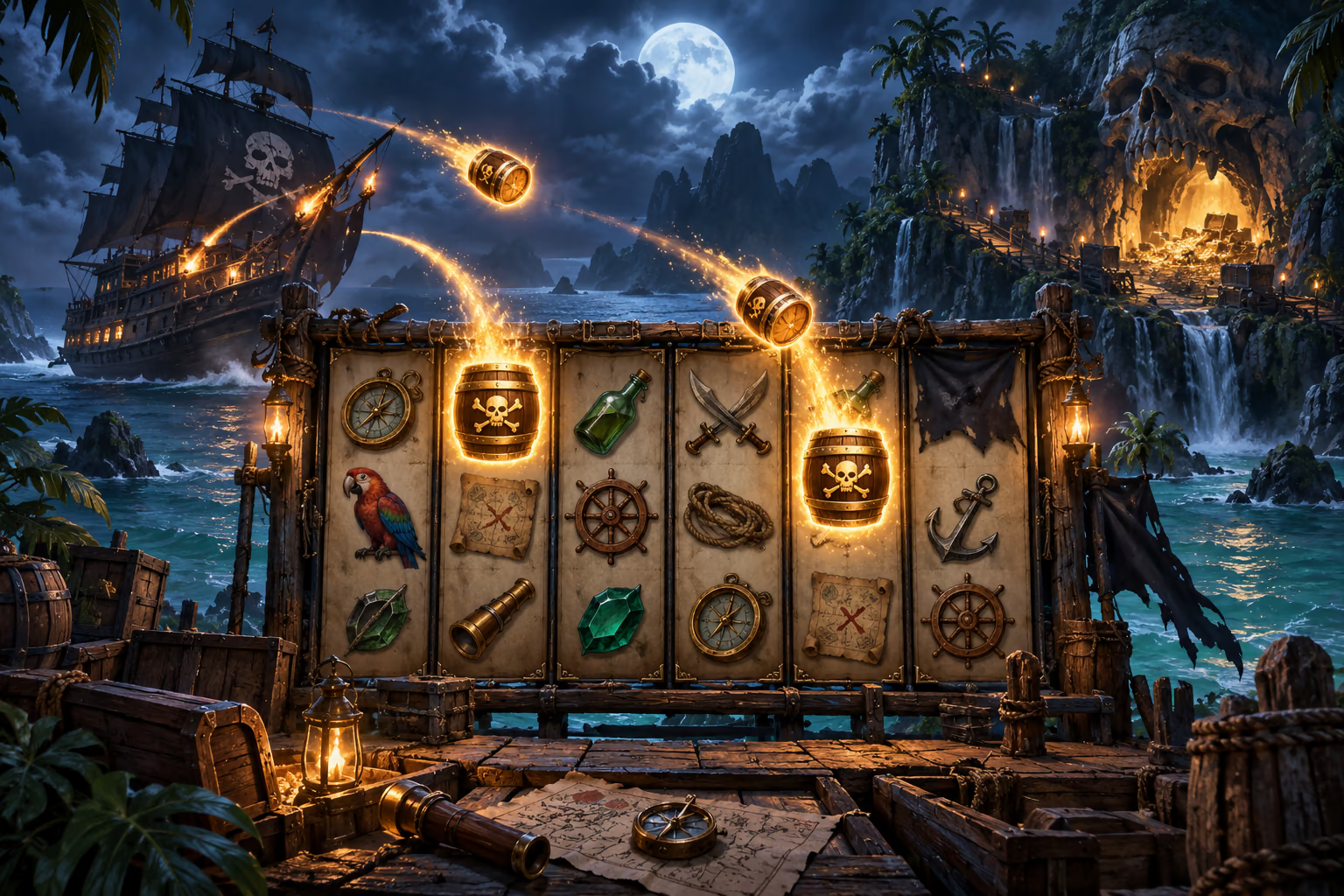
Treasure Island by Quickspin combines Pirate Attack, Treasure Hunt and a multi-feature Free Spins bonus. The official page also identifies stacked Wilds, but each named feature needs to be read separately.
Pirate Attack
Two or more Barrel Wild symbols trigger Pirate Attack. A pirate ship bombards the reels and leaves Wilds on random positions. The source does not promise a fixed number or fixed locations, so the result must be read from the completed feature.
Free Spins feature picks
Free Spins begin with a pick-and-click stage that awards both the number of spins and the active extras. Three possible extras are listed: Super Wilds with unusually long stacks; Extra Wilds that convert one or more medium symbols for the full bonus; and Locked Barrel Wilds that keep Pirate Attack Wilds locked for the remainder of the bonus.
Treasure Hunt
Treasure Hunt is a separate pick-and-click bonus. Its goal is to find Ben Gunn’s cave. The product page does not publish the pick count, prize table or trigger, so those fields require the active game help.
Evidence limits
The public page does not expose readable RTP, stakes, layout or paytable data and does not confirm New Zealand casino availability.
What the official description actually establishes
The source identifies three separate bonus systems rather than one interchangeable “pirate feature”. Pirate Attack begins when at least two Barrel Wilds land. Free Spins use a pick stage to determine both the spin allocation and which extras will operate. Treasure Hunt is another pick-and-click event whose stated objective is to locate Ben Gunn’s cave. Keeping those systems separate is the foundation of an accurate review.
The same source names stacked Wilds and describes three possible Free Spins extras: Super Wilds, Extra Wilds and Locked Barrel Wilds. It does not expose a readable reel layout, line or ways structure, symbol-value table, probability model, RTP, stake interval, feature frequency or maximum exposure on the accessible product page. Those omissions are not minor: they prevent a reviewer from calculating returns or describing a complete paytable from the promotional overview alone.
The official wording also places limits on what can be said about Pirate Attack. It confirms random Wild placement after the ship attacks, but it does not promise a minimum number of added Wilds or identify predetermined cells. A completed board can document one occurrence. It cannot be used to claim that the same arrangement, count or result will recur.
Building a Pirate Attack evidence record
Start with the paid-spin grid that contains the trigger. Mark every Barrel Wild by reel and row, then verify that at least two qualifying symbols are present on the same stopped result. Do not count ordinary stacked Wilds, barrels used only as decorative artwork or symbols seen during the spin animation. The final grid and game history are the useful evidence.
Create a second grid for the state immediately after the ship bombardment. Label every position changed to Wild and distinguish those additions from the Barrel Wilds that caused the attack. If the interface resolves wins before and after the transformation, record the settlements in the displayed order. The purpose is to show what the attack changed, not merely to save a dramatic final screenshot.
Random placement makes coordinate-level recording important. “Several Wilds appeared” is too vague for a support case. A ledger should list the round identifier, original trigger cells, attack-added cells, balance before the stake, credited result and any intermediate amount presented by the client. If a cell changes more than once during animation, retain the final settled state and any available event history.
The public source does not define whether the attack can repeat within the same round, how overlapping Wilds are handled or whether any reel is excluded. Those questions belong to the deployed help. Until that evidence is captured, the article should not turn a single recorded animation into a universal rule.
Reading the Free Spins selection screen
The Free Spins entry stage makes two selections consequential: the number of spins awarded and the extras enabled for that bonus. Record the complete choice screen before making a selection. A useful capture shows every available option, the chosen path, the confirmation state and the first bonus grid. If the selection is automated or timed, record that behaviour rather than implying a manual choice was always available.
Do not treat the three named extras as though they must all activate together. The source says the pick stage determines the features included. A review should state which extras were selected in the observed round and leave other combinations unclaimed unless the live rules describe them. The chosen configuration should remain attached to every later bonus screenshot so that a Wild event is interpreted under the correct rule set.
The source does not publish the starting spin values in readable form. Consequently, an editorial example can explain how to document a choice but cannot fill the buttons with invented numbers. The exact allocation must come from the active version. The same rule applies to retriggers, additional picks or limits on combining extras.
Super Wilds: measuring the stack rather than guessing
Super Wilds are described as unusually long stacks. That wording establishes the general form but not an exact height, reel restriction or appearance rate. When the extra is active, note the reel on which each Super Wild appears and count the visible occupied positions on the stopped grid. If the stack extends beyond the visible window or scrolls into view, rely on the result history and payline display rather than estimating from motion.
A long Wild stack can participate in more than one evaluated combination, but the artwork itself has no standalone cash value. The paytable determines substitution rules and symbol awards. The review should therefore show how the stack intersected the actual evaluated lines or ways, not assign a multiplier based on its apparent size.
If stacked Wilds also exist outside the selected Super Wild extra, name them separately. Similar-looking symbols may have different roles depending on mode. Versioned help text is the deciding source when the lobby description and live client use different labels.
Extra Wilds: recording a lasting symbol conversion
The Extra Wilds option converts one or more medium-paying symbols and keeps that conversion active through the full bonus. The important evidence is the identity of the selected symbol before the first Free Spin and its treatment on later grids. Save the selection or reveal screen, then follow the same symbol across the bonus.
“One or more” is a range, not a promise that several symbols will always convert. The observed round should state the exact selected set without generalising it to every session. If two medium symbols are chosen, label both; if only one is shown, do not add another to make the feature sound richer.
The source does not provide the complete medium-symbol list or explain selection weighting. Obtain both from the active paytable if published there. A conversion may increase the number of Wild positions visible on a particular spin, yet it does not guarantee a paying route. Settlement still depends on the game’s actual evaluation pattern and symbol placement.
Locked Barrel Wilds: persistence boundaries
Locked Barrel Wilds modify Pirate Attack during Free Spins by retaining the Wilds placed by the attack for the rest of the bonus. This is a persistence rule, not a claim that an attack happens on every spin. First confirm a valid Pirate Attack trigger in the bonus, then map the Wild positions added by that event and copy those positions into each remaining Free Spin.
Give persistent cells stable identifiers such as L1, L2 and L3. If another attack occurs and creates new locked positions, add a new generation instead of replacing the original map. This makes it possible to test whether every qualifying cell remained locked for the promised duration.
Clear the map when the bonus ends. Nothing in the public description supports carrying locked Wilds into a new paid round or a later bonus. If a reconnect occurs, compare the recovered board, remaining-spin counter and server history before resuming. A missing locked cell is best reported with its first appearance, last correct state and the first grid on which it disappeared.
Comparing the three Free Spins extras
The extras change different parts of the game. Super Wilds alter the length of a Wild stack on an individual outcome. Extra Wilds alter the treatment of selected medium symbols across the bonus. Locked Barrel Wilds preserve the random positions created by Pirate Attack. A clear comparison uses columns for activation, affected object, duration and evidence required.
These distinctions matter when interpreting a screenshot. A tall Wild does not prove a medium symbol was converted. A board containing several lasting Wild cells does not prove that Super Wilds were chosen. The selected feature label and the event sequence must accompany the image.
Nor should the visual intensity of one option be translated into a higher expected return. The public page supplies no option-specific RTP or probability data. Any comparison of mathematical value requires configuration documentation from the exact version, not impressions from a small number of rounds.
Treasure Hunt as a separate audit trail
Treasure Hunt is described as a pick-and-click bonus focused on finding Ben Gunn’s cave. It should receive its own record because its picks are not the same as the Free Spins configuration stage. Capture the trigger from the deployed help, the initial choice board, each selected location, each revealed result and the terminal state.
Do not infer the total number of picks, prize distribution or losing outcomes from the theme. The public page does not publish them. If the live game reveals amounts or objects behind choices, transcribe exactly what the tested round shows and distinguish displayed credits from promotional artwork.
A pick feature can conceal unselected outcomes after completion. Those reveals may help explain the presentation, but they do not show that the player could have changed the server-determined result. Avoid claims about skill or optimal picking unless the official rules explicitly establish that choices affect the outcome.
A worked documentation example
Imagine a paid spin stops with Barrel Wilds at two recorded coordinates. That satisfies the published threshold and Pirate Attack begins. The post-attack board shows three additional Wild positions. The record labels the original trigger cells B1 and B2, the additions A1 to A3, and then stores the settled amount from the round history. It does not claim that three additions are standard.
In a later, separately triggered Free Spins round, the selection screen enables Locked Barrel Wilds. A Pirate Attack during the bonus creates cells L1 and L2. The reviewer copies those coordinates through every remaining bonus grid and records any later generation created by another verified attack. At feature end, the persistence map is closed.
This example illustrates evidence structure only. It deliberately supplies no invented spin count, stake, payout, attack probability or RTP. Actual values belong to the tested game help and round record.
Paytable and configuration checklist
Before publishing numerical fields, open the in-game help and collect the reel layout, evaluation method, symbol values, ordinary and Barrel Wild substitutions, stacked-Wild behaviour, all feature triggers, Free Spins choice values, retrigger rules, stake denominations, RTP and maximum exposure. Record the provider, title, version, operator, currency and verification date beside the data.
If multiple RTP settings are available, identify the one displayed to the tested account. Do not average versions or import a value from another operator. If the maximum win is expressed as a stake multiple, preserve the provider’s definition of stake so the figure is not accidentally multiplied by line bet, coin value or another unit.
The accessible public overview does not provide enough evidence to complete this checklist. The honest result is a list of fields to verify, not a fabricated specification table.
Supplier-sheet findings and a return-panel ambiguity
The current Quickspin page links a two-page supplier PDF. Its second page was rendered and visually checked on 7 October 2026. The information panel identifies treasureisland, a supplier volatility rating of 2.70 on a 1–5 scale, desktop/mobile channels, a €0.50 minimum and default stake, and a €100 maximum. Those are reference-model fields; they do not prove NZD support, the current live configuration or territorial eligibility.
The return panel deserves care rather than an attractive headline copied without context. It prints a 97.07% total and also 97.07% beside the Free Spins-plus-introduction label. Other rows show 65.54%, 1.46% and 6.07%. Adding all four rows mechanically gives 170.14%, not the printed total. This is an observable panel ambiguity, not evidence that the game offers a return above 100%.
Do not repair that table by guessing a replacement percentage, dropping a decimal or assigning a missing component. The sheet attaches a simulation footnote to one field and theoretical-calculation footnotes to others, but the displayed panel does not establish a consistent additive interpretation for every listed value. A supplier clarification or unambiguous launched-game help is needed before treating those rows as a complete contribution breakdown. The printed total can be recorded as a supplier-sheet reference, not a verified universal operator RTP.
The win panel reports an observed 1,844× result in one billion spins. Its wording describes a simulation observation, not a contractual cap or a promise about one session. Keep that sample label separate from any maximum defined by the current game’s rules.
Integration events are not additional cash awards
The same sheet documents game-event counters used for integrations such as achievements, rewards or tournaments. For example, its Pirate Attack event increments for an exploded barrel, while the Scatter event increments for a collected Scatter. These counters describe reportable events; a unit added to an event counter is not automatically one unit of currency credited to an account.
Suppose an imagined event history contains two barrel increments and one settled game credit. A support worksheet should preserve both event entries and the single monetary settlement. Adding the counters to the credit would create a payout the record never showed. Conversely, a missing achievement increment does not by itself establish that the underlying reel win was unpaid. Name which system is disputed—game settlement, feature persistence or an operator’s separate reward integration—and compare evidence from that system.
New Zealand access requires operator evidence
A global Quickspin portfolio page confirms that the provider presents Treasure Island, but it does not confirm that a New Zealand resident can open the game for real-money play. Availability must be checked against the operator’s country terms, account-registration rules, signed-in catalogue and the exact game launch.
The same principle applies to New Zealand dollars, payment methods, identity checks and withdrawal conditions. None can be derived from the game theme or provider page. If a title appears in demo mode but not in an eligible authenticated account, report only the access actually verified.
Record the date because catalogues and jurisdiction controls change. Do not advise the use of location-masking tools or inaccurate registration details. If the operator blocks the jurisdiction, that is the relevant result.
Mobile, keyboard and reduced-motion checks
On a phone, confirm that the trigger grid, feature-selection labels, remaining-spin counter and locked-Wild positions are visible without horizontal clipping. Test portrait and landscape modes, then rotate during a bonus to see whether the selected extras and persistence state survive correctly.
The pick screens should expose focus order and readable names to keyboard and assistive-technology users. Colour alone should not distinguish a Barrel Wild from an ordinary Wild or indicate which feature was selected. If animation can be reduced, verify that the state change remains understandable without the ship bombardment or reveal effects.
After an interruption, compare balance, round identifier, selected extras, remaining spins and persistent cells with the server history. Do not continue if the client state and history disagree.
Session and budget interpretation
Treasure Island presents several stateful features, but none changes the basic need for a pre-set budget and time boundary. Random attack positions, concealed picks and accumulated locked Wilds can make a round feel as though it is moving towards a particular result. The source does not support that conclusion.
Treat each feature as a rule set to verify rather than a reason to extend play. A near-complete-looking board has no documented future value. The player does not control random Wild placement, and a pick theme should not be described as a strategy game without explicit rules proving meaningful influence.
Stop at the chosen limit, preserve any disputed round identifiers and use the operator’s responsible-play controls where available. Feature familiarity can improve record keeping, but it cannot predict the next outcome.
Editorial publication checklist
- Confirm at least two Barrel Wilds on the Pirate Attack trigger grid.
- Separate trigger Wilds from randomly added attack positions.
- Record the selected Free Spins allocation and extras before the first spin.
- Describe Super Wilds without inventing a fixed stack length.
- Identify exactly which medium symbols Extra Wilds converted.
- Carry Locked Barrel Wild positions only through the current bonus.
- Audit Treasure Hunt in a separate pick ledger.
- Source RTP, stakes, layout and maximum from the deployed help.
- Confirm New Zealand access through operator evidence.
- Label editorial artwork as illustration rather than gameplay proof.
Editorial assessment
Treasure Island’s verifiable appeal is the contrast between three kinds of state change: a random attack that adds Wild positions, a configurable Free Spins mode that can alter stacks, symbols or persistence, and a separate cave-search pick feature. That structure gives an editor useful questions to answer, but the public page does not supply the numerical configuration required for a mathematical verdict.
The strongest review therefore follows events rather than promotional adjectives. It proves the Barrel Wild trigger, maps the attack, preserves the chosen Free Spins extras, traces any locked cells and records Treasure Hunt separately. RTP, stakes, local access and undisclosed pick values remain open until primary evidence from the deployed version is available.
Frequently asked questions
What triggers Pirate Attack? Two or more Barrel Wilds.
Where are Pirate Attack Wilds placed? On random reel positions.
How are Free Spins and features selected? Through a pick-and-click stage.
What are the three possible Free Spins extras? Super Wilds, Extra Wilds and Locked Barrel Wilds.
What is Treasure Hunt? A separate pick-and-click bonus centred on finding Ben Gunn’s cave.
Is RTP published on the public page? No readable value is shown.
Is New Zealand availability confirmed? No.
Official source
Bottom line: separate the random Pirate Attack positions, selected Free Spins extras and Treasure Hunt picks when documenting a round.
How to verify the version you can actually open
A provider page proves that a title exists and describes the supplier's intended rules. It does not prove that a casino accepts players in New Zealand, that the title is enabled for a particular account, or that the highest published RTP is the version in the lobby. Treat availability, operator eligibility and product configuration as three separate checks.
Start with identity, then configuration
Open the game only through the authenticated casino lobby. The information or help panel should identify Quickspin, the exact title and the active mathematical return. Compare the reel or grid layout, paylines or cluster rules, named features and symbol behaviour with the official product material. Similar artwork or a matching title is not enough when the help file is missing or inconsistent.
When the supplier publishes several RTP values, report all of them as configurations. Do not assume the highest option is deployed. RTP is a theoretical long-run measure across a very large number of rounds; it is not a refund rate for one player and cannot predict the next result. Volatility is different: it describes how unevenly results are distributed on the provider's scale.
Read stake controls as money, not interface decoration
Provider sheets often quote a reference range in euros. That range does not establish New Zealand-dollar support or the limits in a specific account. Before a paid round, identify the total amount that will leave the balance. If the interface separates denomination, coins and lines, verify the combined total. If Extra Bet is active, calculate its full cost before pressing spin.
Feature-buy prices are multiples of the current bet, not promised returns. A 100x purchase at a $1 stake costs $100; at a $2 stake it costs $200. Availability can vary by market and some mathematical configurations may not support the control. If the live help does not explain the price, delivered feature and active RTP, leave the option unused.
Keep simulation figures in their proper scope
A game sheet may publish a maximum result observed in a large simulation. That is not automatically the contractual maximum payout and never describes a likely session. Preserve the provider's wording, sample size and configuration. Check the live rules for a binding cap and the operator terms for any separate payout limit. Do not turn an extreme result into a promotional headline.
Audit a disputed round
If an animation freezes or a connection drops, do not repeat the wager immediately. Reopen the game through the authenticated lobby and inspect round history. Record the time, total stake, balance movement and round identifier. The result can be settled by the gaming system even when the device never displays the final animation. Send evidence through verified operator support; never disclose a password, recovery phrase or one-time code.
Read the paytable as a calculation document
The paytable should explain what creates a win, which symbols substitute, where special symbols can land and how multiple awards combine. For line games, confirm direction and active paylines. For cluster games, confirm adjacency, minimum group size and the order of collection. For respins, identify what remains locked, what resets the counter and what ends the feature. A graphic effect can illustrate those rules but cannot replace them.
Separate addition from multiplication. Several prize values may be added before a multiplier applies, while reel-specific multipliers can sometimes multiply together only when each reel participates in the same win. Reconstruct one low-stake result from game history. If the arithmetic cannot be matched to the help file, stop and ask the operator rather than guessing.
Do not confuse hit frequency with a profitable round
Provider sheets can publish hit frequency or category probabilities. A hit simply means a round returned a qualifying amount; it can be smaller than the stake. “Big”, “Mega” or “Epic” thresholds are provider reporting categories, not promises. They are useful for comparing mathematical versions only when definitions and samples are the same.
Random outcomes do not become due after a long gap. A feature that appeared repeatedly in a demo or marketing clip has no obligation to repeat in a funded session. Previous rounds do not create a debt from the next random result.
Confirm market and device behaviour independently
A title can exist in the supplier catalogue while an operator disables it for a territory, currency, device or bonus. Language localisation is not evidence of legal availability. Confirm the operator's identity, accepted countries and current lobby separately from the provider review.
On mobile, verify that balance, total bet, feature state and help remain visible without overlap. On desktop, check that browser zoom does not hide a purchase control or change the apparent denomination. Mathematical configuration should not change merely because the screen changes; if the help shows another RTP, treat it as a different deployment and record it.
Keep a compact evidence record
For any fact used in a review, save the title, provider, official URL, document date when available, access date and exact territorial scope. For a live session, add the operator domain, Game ID, RTP, currency and a non-sensitive screenshot of the help panel. This makes later corrections possible when a supplier updates a sheet or an operator changes configuration.
Missing information should remain missing. Do not estimate an RTP from results, convert a euro reference range into an operator's NZD limit, or treat another casino's configuration as evidence. A transparent “not confirmed” is more useful than a precise-looking number without the correct source.
Use limits that survive the feature design
Collection meters, expanding grids, sticky symbols and near misses can make a session feel unfinished. Unless the rules explicitly preserve progress, the visible state has no value after the round or feature ends. Set a money limit and time limit before launch, count feature buys immediately, and stop at the limit even when a meter appears close to an upgrade.
No random game is an income plan. Do not borrow, use essential funds or raise the stake to recover a loss. If play stops feeling recreational, use timeout, deposit-limit or self-exclusion tools and consult the site's responsible gambling guide.
Primary source and correction path
This guide separates documented product information from market availability. Check the official source and the game help inside the exact version offered before making a decision.
